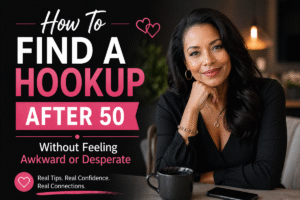
Friends with benefits after 50 sounds simple on paper. Two adults. Mutual attraction. No pressure. No labels. No long-term expectations.
Yet for many women, the idea brings up questions they didn’t expect:
Will I get attached?
Is this empowering or emotionally risky?
Am I “too old” for something casual like this?
Can this actually work — or does someone always get hurt?
The honest answer is this: friends with benefits after 50 can absolutely work, but only when it’s entered with clarity, boundaries, and emotional self-awareness.
Friends with benefits after 50 can sound simple—connection, chemistry, and no pressure. But for many women, it raises important questions about emotions, boundaries, and whether it truly works long-term.
At this stage of life, more women are exploring FWB relationships as part of casual dating after 50—seeking intimacy without commitment or emotional exhaustion.
So can friends with benefits after 50 actually work? The answer is yes—but only with clarity, communication, and strong boundaries.
In this guide, you’ll learn when FWB works, when it fails, and how to navigate it with confidence and self-respect.
How to Make Friends With Benefits After 50 Work
A successful FWB relationship after 50 doesn’t happen by accident. It works when both people are clear, honest, and emotionally grounded.
Step 1: Be Honest About Your Intentions
Know why you want a friends with benefits arrangement. Is it companionship, physical connection, or something light and consistent?
Clarity helps prevent confusion later.
Step 2: Choose the Right Person
FWB works best when both people want the same thing. Avoid situations where one person is secretly hoping for more.
Step 3: Set Boundaries Early
Discuss expectations around time, communication, exclusivity, and emotional involvement.
Boundaries keep the experience enjoyable instead of complicated.
Step 4: Communicate Regularly
Check in when needed. If something shifts, address it early instead of ignoring it.
Step 5: Stay Emotionally Aware
Pay attention to how you feel over time. If the situation no longer fits, give yourself permission to step away.
Why Friends With Benefits After 50 Appeals to Women
At this stage of life, many women are not looking to merge lives, raise families, or start over from scratch. What they are looking for is connection without complication.
FWB relationships often appeal because they offer:
- Physical intimacy without long-term obligation
- Consistency without emotional labor
- Familiarity without pressure
- Freedom to prioritize personal life
- Sexual connection without redefining identity
For women who value independence, this can feel refreshing rather than limiting.
Friends With Benefits Is Not a “Failure to Commit”
One of the biggest misconceptions is that choosing an FWB arrangement means you’re avoiding commitment because you’re afraid.
That’s not usually true at all.
For many women over 50, FWB is a conscious choice, not a fallback plan.
Real Talk: Choosing what fits your life right now is not avoidance — it’s self-respect.
What Friends With Benefits After 50 Really Looks Like
FWB after 50 often looks very different than it did at 25.
It’s usually:
- More honest
- Less chaotic
- More respectful
- Less impulsive
- More intentional
It’s not about late-night confusion or mixed signals. Ideally, it’s about two emotionally mature adults agreeing on the things.

When Friends With Benefits After 50 Works Well
FWB relationships tend to work best when:
- Both people are emotionally stable
- Expectations are discussed early
- There is mutual respect
- Communication is consistent
- Neither person is secretly hoping it turns into something else
Clarity is everything.
When Friends With Benefits After 50 Fails
FWB often falls apart when:
- One person wants more but stays silent
- Boundaries are assumed instead of discussed
- Emotional needs are ignored
- Jealousy creeps in
- One person treats it as disposable
Problems don’t come from the structure — they come from unspoken expectations.
Emotional Honesty Is the Foundation
Before entering an FWB situation, ask yourself:
- Can I enjoy intimacy without attachment right now?
- Am I emotionally fulfilled in other areas of life?
- Am I hoping this turns into something more?
- Do I feel grounded in my boundaries?
There are no wrong answers — only honest ones.
Friends With Benefits vs Casual Dating After 50
These two often get confused, but they are not the same.
Friends with benefits usually involves:
- Ongoing familiarity
- Repeated intimacy with the same person
- Some level of friendship
Casual dating often includes:
- Seeing multiple people
- Less consistency
- More exploration
Neither is better. The key is choosing what aligns with your emotional capacity.
Boundaries for Friends With Benefits After 50
Boundaries are non-negotiable in FWB relationships.
Healthy boundaries include:
- Clear communication about expectations
- Agreement on exclusivity or non-exclusivity
- Respect for time and availability
- Emotional check-ins when needed
- Freedom to walk away without guilt
FWB should feel easy, not emotionally draining.
Many women exploring casual dating after 50 find that friends with benefits offers a balance between connection and independence.
The Role of Communication (And Why It Matters More Now)
At this stage in life, communication is a skill — not a guessing game.
Conversations you must have early:
- “What does friends with benefits mean to you?”
- “Are you dating other people?”
- “How do we handle emotional shifts if they happen?”
- “What are deal-breakers for you?”
Avoiding these conversations doesn’t keep things light — it creates confusion.
Can Women Catch Feelings in FWB Relationships?
Yes — and that doesn’t mean you failed.
Feelings can develop because:
- Sex increases emotional bonding
- Familiarity creates comfort
- Vulnerability builds trust
Catching feelings isn’t the problem. Ignoring them is.
What to Do If You Start Wanting More
If feelings shift:
- Acknowledge them honestly
- Communicate without pressure
- Observe the response carefully
- Decide what honors you most
If the arrangement no longer fits, it’s okay to walk away.
Real Talk: Staying in a situation that no longer serves you is far more painful than ending it.
Respect Is Non-Negotiable
FWB does not mean:
- Being on standby
- Accepting disrespect
- Ignoring your needs
- Feeling disposable
Respect shows up as:
- Consistent communication
- Consideration of your comfort
- Emotional maturity
- Honesty
Anything less is not worth your energy.
Friends With Benefits Can Be Empowering
When done well, FWB after 50 can:
- Reinforce body confidence
- Normalize pleasure
- Support emotional independence
- Reduce dating burnout
- Create joyful connection
It’s not about labels — it’s about how you feel within the experience.
If you’re exploring different dating styles, read our guide on Dating Multiple People After 50 to understand your options.
When Friends With Benefits No Longer Fits
FWB is not meant to last forever — and that is okay.
It may stop fitting when:
- Emotional needs change
- You want exclusivity
- You desire deeper connection
- The dynamic feels unbalanced
Growth does not mean failure. It means evolution.
Letting Go Without Guilt
Ending an FWB arrangement respectfully is a sign of maturity.
You don’t owe:
- Extended explanations
- Apologies for changing
- Emotional labor beyond honesty
You owe yourself alignment.
Final Thoughts on Friends With Benefits After 50
Friends with benefits after 50 can absolutely work — when it aligns with who you are and what you want right now.
It’s not about proving independence.
It’s not about avoiding intimacy.
It’s not about settling.
It’s about choice.
Your desires matter.
Your boundaries matter.
Your emotional safety matters.
You get to decide what connection looks like in this chapter — and that freedom is powerful.
Thinking about trying friends with benefits after 50? Start with honesty, trust your instincts, and choose what feels right for you. The goal is connection—not confusion.